

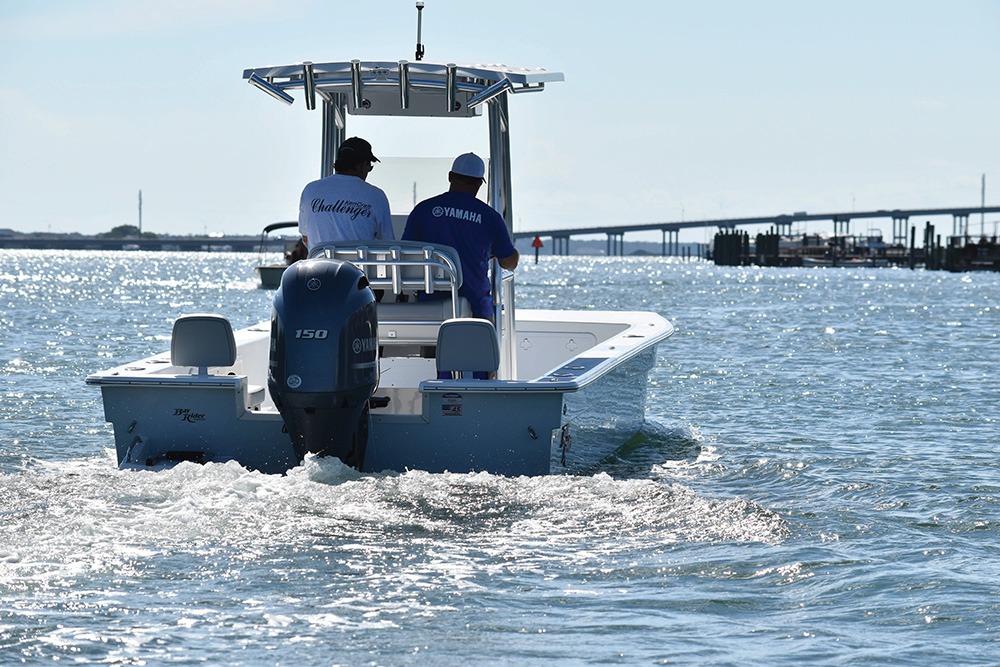
Not too long ago I drove down to the Outer Banks of North Carolina, determined to take a break from all this architecture writing, and search for fresh fish in the waters of Pamilico Sound. It surrounds the community of Wanchese, an authentic fishing village that’s been operating for centuries. I was a guest of Chris McDonald, owner of First Light Charters, who took me out for five hours on his 24-foot KenCraft. It was a beautiful day, but alas, not so much when it came to fishing. I filed my story with the Virginia Sportsman anyway, and A+A is pleased to post it here today:
It’s an early June afternoon, and I’m quietly seeking solace at the bar of Tortugas Lie in Nags Head, N.C. Before me is a glass of Sauvignon Blanc, a cup of ice, a pair of Mahi Mahi tacos, a pool of black beans with a dollop of sour cream, a generous portion of yellow rice, a few sliced Jalapeno peppers and a slight scoop of red sauce.
I’m not exactly morose, but I am sorely disappointed.
It’s 3 p.m. at this surfer bar posing as a Caribbean outlier. Nailed to the walls and ceilings are hundreds of vanity plates, mostly from Carolina and Virginia. They read like memes: SRFN LIFE, RDNECK, SMK IT UP, HOSER, NAUDI 1, BADGRL, NGS HED, MRJUCE—and one from the rarified air that permeates Mecca’s West End, TUCAHO.
I’ve recently returned after five lackluster hours—from 7 a.m. to noon—on Pamlico Sound with Chris McDonald, owner and intrepid guide from First Light Charters out of Wanchese. That’s a tiny fishing village 10 minutes south of Manteo on NC Route 345. It’s the last scrap of authenticity (aside from this spot, plus Sam & Omie’s and Awful Arthur’s) on the now-overcooked Outer Banks.
Wanchese is a true working community of commercial fishermen, shrimpers, dredgers, tugboat captains and all manner of native Outer Bankers—not the “come-heres” from parts North. That hungry species has been striving mightily to modernize the rustic essence of these barrier islands for five decades now. Sadly, they’ve succeeded.
But don’t take my word for it. Here’s how the Richmond Times- Dispatch’s Charles McDowell described the trend in a column back on Sept. 3, 1961:
“The Outer Banks of North Carolina, only recently the remote retreat of tourists who preferred lonely sand and wind and waving sea oats to the company of other tourists, is rapidly becoming one of the great tourist thoroughfares of the East Coast.
“New bridges, new roads and better ferry schedules are bringing streams of travelers across Currituck Sound from the north, across Croatan Sound to Roanoke Island from the west, and up the thin sand strip of Ocracoke Island from the south.
“Cape Hatteras, which used to be the very symbol of windswept loneliness in this part of the country, had nearly 150,000 visitors in one month this summer.”
By 2021, Cape Hatteras National Seashore had hosted a record of three million tourists. But not little Wanchese. No, this community perched on the southern tip of Roanoke Island is home to fewer than 2,000 working residents. There are bait shops, boat builders, diesel tanks, seafood processing plants and a water tower labeled “Wanchese Harbor.” It’s the tallest structure around, one that dwarfs the tiny shingle-style homes sprinkled about.
The marina here is populated with a wide assortment of pleasure craft, charter boats and long-term, heavy-duty, commercial fishing vessels. Think: “Wicked Tuna OBX.” “They work out of here,” McDonald says.
This 32-year-old is an Outer Banks native, educated at first at Kitty Hawk Elementary, then Kill Devil Hills Middle and High Schools. He earned his captain’s license at the nearby Coastal Studies Institute, taking an eight-day course and passing the test on his first try.
He started fishing these waters early. “Growing up around here, you go surfing when the waves are good, and you fish when they’re not,” he says. “I kind of fell in love with fishing and ran away with it.”
He began with kayaks and a jon boat—a 20-foot KenCraft—from the Eastern Shore. Next up: a Carolina skiff. Now he pilots a 24-foot, flatbottom KenCraft Bay Rider powered by a Yamaha 150. It’s the perfect vehicle for the quick spurts and scoots needed in the shallow water on the sound side. From it, McDonald’s caught his share of citation trout and drum.
He and I started the day early at T